
I was just a player. I logged into Genshin Impact, listened to Paimon chatter in my ear, and never thought much about who was behind that voice. Then I stumbled into the 2023 pay dispute that hit the English voice cast, and suddenly the game felt different. Paimon was not just a floating mascot anymore; she was a person with rent, bills, and a very awkward silence coming from the business side of the industry. That one hit me in the gut.
The Voices Behind the Adventure
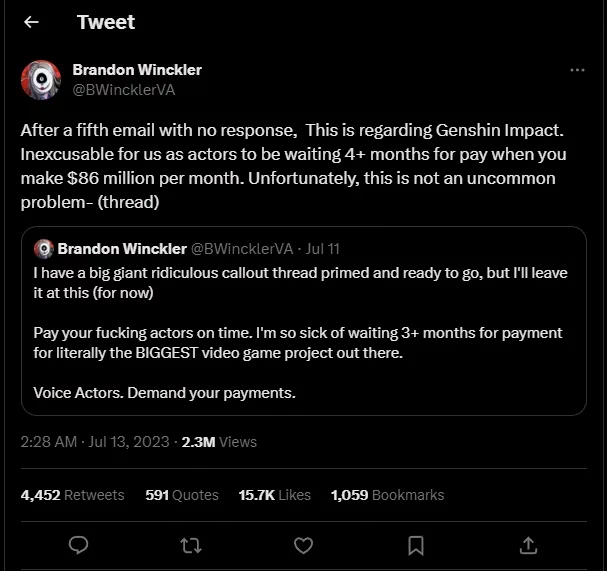
Brandon Winckler, a voice actor with many minor roles and additional voices in Genshin Impact, spoke first. He said he had sent multiple emails with no response and had been waiting months for payment while the game was pulling in enormous monthly revenue. He called it “inexcusable” and said he personally would not keep working on the game unless it moved under a union contract. That was not a vague complaint. It was a very human math problem: waiting four or more months for pay while the project is making money hand over fist.
Corina Boettger, the English voice of Paimon, followed with a message that felt even more personal. Boettger said they had been working for months unpaid on a big project and were owed thousands of dollars. They said they were struggling to pay rent because of it. They also made clear they were not sure whether HoYoverse or Formosa Interactive was to blame, but they believed a union contract would have prevented the situation. Boettger said they had not been at the studio to record for the last two days because of the dispute.
As a player, that was the moment the curtain got yanked back. I had been treating the voice cast like part of the scenery. They were not scenery. They were workers.
The Studio, the Union, and the Silence
The key detail was that Genshin Impact’s English voice work was a non-union production. That meant no Screen Actors Guild protections covering the actors in the same way as a union project. Formosa Interactive, the studio handling English voice recordings, said on its website that it worked with both union and non-union projects. That can mean lower rates, less leverage, and payment dates that feel like they are written in fog.
HoYoverse later said it had been paying the recording studio on time and supported the voice actors in claiming what they were owed from that company. The statement said HoYoverse had urged the studio to pay the actors and was seeking alternative solutions. That matters, but it did not magically fix the feeling among fans that the people bringing the game to life were left waiting.
Here is the simple version I keep in my head:
| Claim or detail | Why it mattered to me |
|---|---|
| Actors waited months for payment | Rent does not wait for a patch update 💸 |
| The project was non-union | Union coverage could have created firmer payment protections 🛡️ |
| HoYoverse said it paid the studio on time | The blame game became part of the story 🤷 |
| Formosa handled English recording | The actors’ grievance pointed toward the studio layer 🎙️ |
The silence from the business side felt like a locked door. The invoice sat there like an uninvited guest at the dinner table. And the game’s giant revenue number seemed to stare back at me every time Paimon opened her mouth.
Why 2026 Me Still Cares
As I write this in 2026, the specific tweets are old, but the questions are not. Game production has only become more global, more layered, and more dependent on contractors. Voice actors can be essential to a blockbuster while still sitting outside the protections that other entertainment workers take for granted. That is a strange bargain. It is also a bargain fans should understand, because we are the ones who fall in love with the performances.
I am not here to pretend I know every contract clause. I am not a lawyer, and I am not a voice actor. I am just a player who now listens differently. When Paimon makes a joke, I hear the writing, the direction, the recording, and the person who had to wonder whether the paycheck would arrive. Honestly, oof. That is not the fantasy I signed up for.
What I take away from the whole mess is this:
-
Fame is not the same as fairness. A character can be beloved worldwide while the performer behind it is chasing basic payment. 🌍
-
“Non-union” is not a small label. It shapes pay, protections, and how quickly problems get solved. 📄
-
Fans can care without turning into accountants. We do not need to settle the legal blame to say workers should be paid on time. ❤️
-
The industry keeps talking about unions for a reason. The 2016–2017 SAG-AFTRA video game strike was not ancient history; it was a warning light. 🚨
No shade to anyone who just wants to play the game and avoid industry drama. I get it. Sometimes I want to log in, do my dailies, and not think about labor law. But the Paimon situation stuck with me because it was so clean and so ugly at the same time: a billion-dollar game, a beloved voice, and months of unpaid work. If that can happen here, it can happen anywhere.
So when I hear Paimon now, I still smile. But I also remember the people behind the microphone. They are not extra voices. They are the reason the world sounds alive.
Insights are sourced from Game Developer, whose industry reporting helps frame why payment disputes in game voice work matter beyond a single title: when production is split across publishers, recording studios, and freelance performers, delays can expose how fragile non-union labor protections remain even on globally successful games.