
I still remember the chill that ran down my spine during CES 2024 when Nvidia first lifted the curtain on their AI-powered NPC technology. It was one of those moments that splits your perception of reality into a 'before' and an 'after'. Now, in 2026, sitting in my gaming chair with a controller in hand, I realise I'm no longer just playing a game. I'm having conversations that feel unnervingly real, and it all started with that quiet, uneasy announcement two years ago.
Back then, the promise was intoxicating: non-player characters with 'revolutionary conversational, perceptual, and action generation capabilities'. Nvidia spoke of endless possibilities, and within days, two giants stepped forward. HoYoverse and Ubisoft were among the first to grab a slice of the future, signing deals that clearly had been whispered about long before the public reveal. I remember Digital Trends breaking that news, and my first thought was: Genshin Impact dialogue is about to get dangerously interesting. My second thought was: what fuels these machine-minds?
That question still lingers, a phantom at the feast of innovation. When journalists asked Nvidia directly how the tech was being trained—specifically to write and voice characters—the answer was a polite fog. “No simple answer,” they said. Different tools, different datasets. Two years on, we have more breathtaking AI interactions in video games than ever, but not a drop more transparency. The black box remains locked.
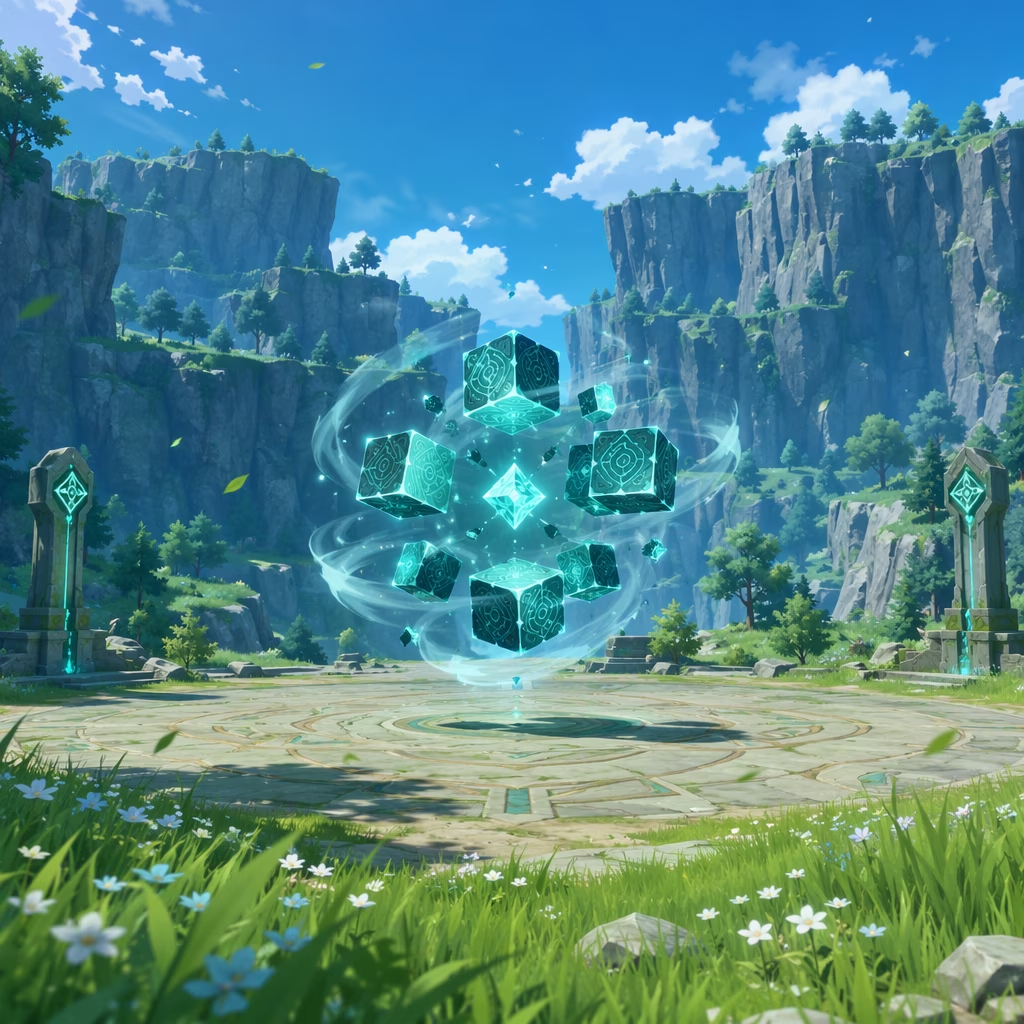
The New Conversation: When Paimon Stopped Reading a Script
I booted up the latest Genshin Impact expansion last month and wandered into Liyue, expecting the familiar looping phrases of tired merchants. Instead, an NPC soldier I’d ignored for years asked me about the weather in Mondstadt and then segued into a melancholic reflection on his childhood. It wasn't a quest trigger; it was a living tangent. His language shifted from formal to colloquial, he referenced my recent actions, and his voice—a voice I later learned was entirely generated by Nvidia’s avatar cloud engine—carried micro-emotions I couldn’t just dismiss as vocal fry or modulation. I felt seen, and that terrified me.
Ubisoft’s next Assassin’s Creed title, codenamed Nebula, takes this even further. Every civilian profile is now a seed, and interactions evolve based on systemic memory. Here’s what a five-minute walk through 2026 Baghdad taught me:
-
🗣️ Dynamic Memory Threads: A fruit vendor remembered I had haggled aggressively the day before and greeted me with cautious sarcasm. No script flag, just emergent recall.
-
🎭 Perceptual Reactivity: I climbed a wall, and a child below whispered to her mother about a ‘jumping ghost’. My stealthy approach was pre-empted by an elderly man who simply said, “You move like wind, but you sound like a stranger.” The AI tracked my controller input patterns.
-
⚖️ Moral Drift: I solved a dispute by bribing a guard. The AI-generated speech for the magistrate included a subtle shift in tone that felt like disappointment, even though no ‘reputation meter’ moved. It was pure linguistic inference.
I’m not reporting bugs here. The tech works almost too well. But the soul of these interactions is haunted by the unsolved riddle of their origin.
The Voices We’ll Never Hear
The silence from Nvidia on training data has grown louder with every release. Voice actors foresaw this disaster. Back in 2023, when Microsoft teased similar AI voice tools, a veteran performer lashed out: “If you want to start a voice-acting career, don’t bother.” Another warned it would make it harder for new talent to break in. They were right. I searched last week and found a forum thread titled “My first voice role was training the AI that replaced me”. It had over twelve thousand upvotes.
Here’s what keeps me up at night:
| Concern | 2024 Status | 2026 Reality |
|---|---|---|
| Data Provenance | Nvidia admitted multiple datasets, no consent clarity | Still no public audit; lawsuits pending in UK and Canada |
| Actor Consent | Widespread worry | SAG-AFTRA intermediate contract requires opt-in, but ‘legacy’ voices remain murky |
| Creative Stagnation | Theoretically endless variety | Players report ‘emotional flattening’ in long playthroughs—AI patterns repeat in unexpected ways |
I’ve noticed the flattening myself. After 60 hours with some NPCs, they start to feel like exceptionally brilliant parrots. The illusion holds only as long as your own attention span permits. It’s not that they become repetitive in the same way old dialogue trees did; it’s that they settle into a GPT-esque rhythm of friendly affirmation and safe philosophical generalities. You can almost smell the guardrails.
A Window, Not a Mirror
Yet I can’t be a pure cynic. Last weekend, my partner watched me play and gasped when a Raiden Shogun AI replica (a special event character, entirely generated) spoke to me in a cadence of haunting grief about transience. She isn't a gamer. “That actress must be a genius,” she whispered. I didn’t have the heart to explain the actress was a composite of consenting voice samples from three volunteers and a vast, unrevealed sea of unknown historical recordings. The performance was beautiful. The ethics, obscured.
Nvidia’s 2024 promise of “endless possibilities” has, in 2026, translated into a desperate need for us as players to cultivate a new kind of literacy. I now play games with a sense of dual awareness: I allow myself to be moved, but I also keep a mental ledger of what might have been stolen to move me. The partnership between HoYoverse and Ubisoft with the tech giant has undoubtedly given us narrative textures we never dreamed of—a market stall tale in Baghdad that made me cry, a mountain pass in Teyvat where an NPC revealed my own in-game travel habits back to me as a friendly joke.
When I step back, I see an industry at a crossroads. We’ve accepted AI upscaling for textures without much fuss, but conversational AI cuts directly into the heart of what makes games feel human. The joy of identifying a voice actor’s signature warmth is being replaced by a smooth, impersonal marvel. I’ll keep exploring these worlds, because the tech is undeniably magical. But I’ll also keep asking the question Nvidia never answered: whose ghost did you capture to teach these machines how to speak to me?